
Official MemoryFuel Supplement Facts: Label Transcript, Milligrams and What They Mean
Every line of the MemoryFuel panel typed out and explained, with the maker's own label artwork, the cautions printed on the jar, and the four places where advertising and label do not match.
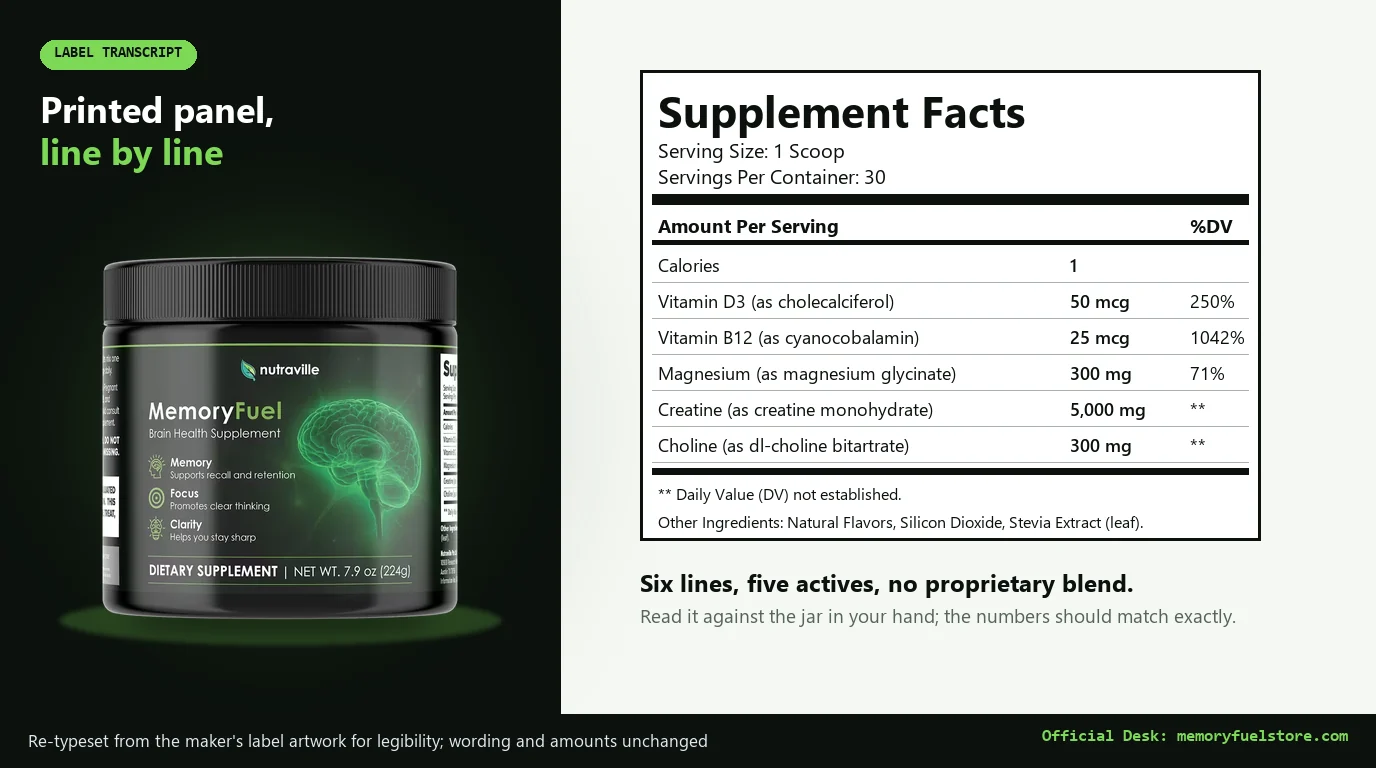
The MemoryFuel Supplement Facts panel, transcribed
Below is every line of the panel typed out, followed by the actual label artwork from the maker for comparison. If the jar in your hand shows something different, the jar is the authority; formulas can be revised, and a revised label beats any website.
Supplement Facts
Servings Per Container: 30
Other Ingredients: Natural Flavors, Silicon Dioxide, Stevia Extract (leaf).
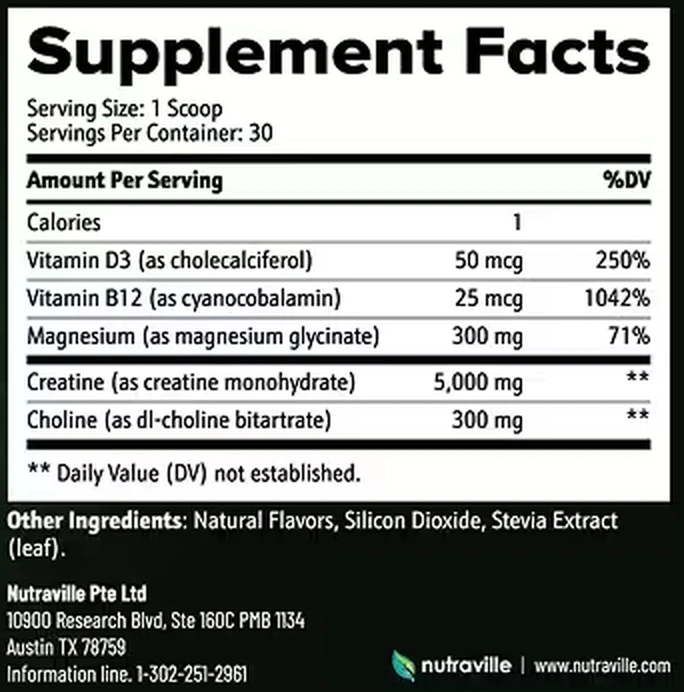
How to read each part of the panel
Serving size: 1 scoop. The jar holds 7.9 oz (224 g) and 30 servings, so one scoop is about 7.5 g. That weight is mostly creatine (5 g) and magnesium glycinate (around 2 g), which is why the scoop is larger than a typical vitamin powder serving.
Calories: 1. Stevia sweetens the drink without sugar, so energy content is negligible. This matters for anyone counting carbohydrates.
%DV. The percent Daily Value compares the amount to a reference intake set by the FDA for labeling. Values over 100 percent are common for vitamins and are not automatically a problem; what matters is the upper limit, which is a separate number[1].
Double asterisks (**). Creatine and choline show ** because no Daily Value has been set for them on supplement labels in this format. It does not mean the amount is unknown.
Line-by-line notes
Vitamin D3 50 mcg (250% DV). Labels now list vitamin D in micrograms; 50 mcg equals 2,000 IU. The DV is 20 mcg (800 IU). The adult upper limit is 100 mcg (4,000 IU)[3].
Vitamin B12 25 mcg (1042% DV). The DV is 2.4 mcg. Ten times the DV sounds high, but only a fraction of oral B12 is absorbed at larger doses, and B12 has no established upper limit[4].
Magnesium 300 mg (71% DV). The DV is 420 mg, so 71 percent confirms this is elemental magnesium. The upper limit for supplemental magnesium is 350 mg a day[5].
Creatine 5,000 mg. Listed as creatine monohydrate. Five grams is the standard daily maintenance amount in research[7].
Choline 300 mg. Listed as dl-choline bitartrate. We read 300 mg as choline itself; the adequate intake is 425-550 mg[6]. If you want certainty, ask the maker whether the figure refers to choline or to the bitartrate salt.
Other ingredients
Natural flavors, silicon dioxide and stevia extract (leaf). Silicon dioxide is an anti-caking agent. Stevia provides sweetness. There are no artificial colors listed, no sugar and no caffeine.
The panel image does not carry an allergen statement. If you have food allergies, read the physical jar, since labels on the product can include information not visible in website images, and contact the maker if anything is unclear.
What the front of the jar claims
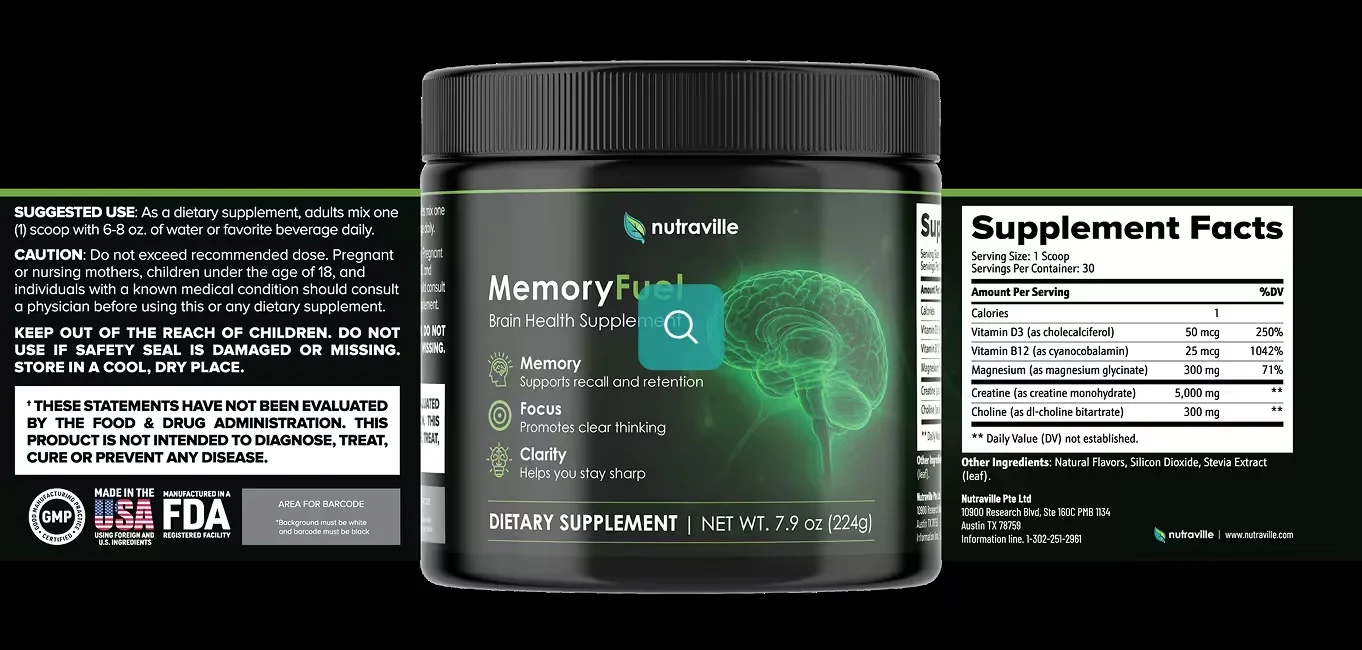
The front panel reads "MemoryFuel, Brain Health Supplement," with three statements: Memory ("supports recall and retention"), Focus ("promotes clear thinking") and Clarity ("helps you stay sharp"). These are structure-function claims, the kind supplements are allowed to make without FDA approval, as long as they do not claim to treat a disease and they carry the standard disclaimer.
Below that: "Dietary Supplement | NET WT. 7.9 oz (224g)," and the Nutraville logo.
Suggested use and cautions printed on the label
Suggested use: as a dietary supplement, adults mix one scoop with 6 to 8 oz of water or a favorite beverage daily.
Cautions: do not exceed the recommended dose. Pregnant or nursing mothers, children under 18, and individuals with a known medical condition should consult a physician before use. Keep out of reach of children. Do not use if the safety seal is damaged or missing. Store in a cool, dry place.
We would add one practical note the label does not: creatine raises blood creatinine, a lab marker of kidney function, without harming the kidneys in healthy people[8]. Mention MemoryFuel to your doctor before routine blood tests.
Who makes it, according to the label
The back panel names Nutraville Pte Ltd, 10900 Research Blvd, Ste 160C PMB 1134, Austin, TX 78759, an information line at 1-302-251-2961, and the website nutraville.com. It also carries a GMP seal, "Made in the USA using foreign and U.S. ingredients," and "Manufactured in an FDA registered facility."
Two of those phrases are easy to misread. "FDA registered" means the facility is registered with the FDA, which all food and supplement facilities must be; it is not an FDA approval of the product. "GMP" refers to the current Good Manufacturing Practice rules for supplements in 21 CFR Part 111, which require identity testing of ingredients and quality controls[2]. The label does not show a third-party certification seal such as USP or NSF.
Where the label and the advertising disagree
We compared the panel with the maker's sales pages. Four differences stood out. None of them makes the product unsafe, but they matter for anyone who reads carefully.
| Item | Advertising says | Label says |
|---|---|---|
| Number of actives | "Six ingredients" incl. L-theanine 200 mg | Five actives; no L-theanine |
| B12 form | Methylcobalamin | Cyanocobalamin |
| Magnesium wording | "300 mg of magnesium glycinate" | Magnesium 300 mg (as glycinate), i.e. elemental |
| Choline wording | "300 mg of choline bitartrate" | Choline 300 mg (as dl-choline bitartrate) |
Our rule is simple: when they differ, the label wins, because the label is what is regulated and what is in the jar.
Certificate of analysis: what exists and what to ask for
A certificate of analysis (CoA) is a lab report for a specific production lot. A useful one names the lot number, tests identity, measures each active against the label claim, and screens for heavy metals and microbes.
The maker does not publish CoAs on its website, and this desk does not have one. We will not post an invented lab sheet, which unfortunately some sites do. If you want one, email the maker with the lot number printed on your jar and ask for the matching CoA. A company that runs proper GMP testing should have these records; how quickly it answers is a reasonable signal in itself.
Totals if you take other supplements
Many MemoryFuel buyers already take a multivitamin, vitamin D or magnesium. Add the amounts together and compare with the adult upper limits[9].
| Nutrient | MemoryFuel | Adult upper limit | What to check |
|---|---|---|---|
| Vitamin D3 | 2,000 IU | 4,000 IU | Add any multivitamin or separate D3; many multis carry 800-2,000 IU. |
| Magnesium (supplemental) | 300 mg | 350 mg | A multivitamin with 100 mg Mg puts you over; watch for loose stools. |
| Choline | 300 mg | 3,500 mg | Very wide margin; food choline does not count toward the limit concern. |
| Vitamin B12 | 25 mcg | None set | No upper limit; excess is excreted. |
| Creatine | 5,000 mg | None set | Do not stack with a separate creatine product unless your doctor agrees. |
Using this panel to compare memory supplements
A Supplement Facts panel is the most useful comparison tool you have, and most shoppers never read it. When you hold MemoryFuel up against another brain product, five questions do most of the work.
- Are the amounts printed for each active? A proprietary blend hides how much of each ingredient you get. MemoryFuel prints them all; many competitors do not.
- Do the amounts match research doses? Creatine trials for memory use around 5 g a day. A capsule product listing 250 mg of creatine is unlikely to deliver comparable stores.
- How many servings per container, and how big is a serving? A cheaper jar with 20 servings, or a serving of three capsules, changes the real cost per day.
- What do the other ingredients add? Sugar, artificial colors and fillers show up here. MemoryFuel's list is short: flavors, an anti-caking agent and stevia.
- Who stands behind it? A named company, an address and a phone number on the label are the minimum. MemoryFuel's back panel provides all three.
Answering those questions honestly will not tell you whether a product works for you, but it will quickly separate formulas built around meaningful doses from formulas built around a long ingredient list.
Label checklist for when your jar arrives
When the parcel lands, take two minutes before the first scoop. First, check the safety seal under the lid: the label says not to use the product if it is damaged or missing. Second, compare the front panel with the photo on this page: the Nutraville logo, "MemoryFuel Brain Health Supplement" and "NET WT. 7.9 oz (224g)" should all be there. Third, read the Supplement Facts box on your jar against the transcript above. Fourth, find the lot number and best-by date, usually printed or stamped on the jar's base or label edge, and note them on your order email.
Store the jar closed, in a cool and dry cupboard rather than next to the stove or in a steamy bathroom. Creatine and magnesium powders clump when they pick up moisture; clumping does not make them unsafe, but it makes measuring a level scoop harder. Use a dry scoop every time. If the powder smells off, changes color or arrives with a broken seal, do not use it; contact the maker with your ClickBank order number. Our jar check tool walks through the same steps interactively.
Questions about this topic
What is the serving size of MemoryFuel?
One scoop, about 7.5 g, mixed into 6 to 8 oz of water or another drink once a day. Each 7.9 oz jar holds 30 servings.
How much creatine is in MemoryFuel?
5,000 mg (5 g) of creatine monohydrate per scoop, the standard daily dose used in creatine research.
Does MemoryFuel have a proprietary blend?
No. Every active ingredient has its own printed amount, which makes it easy to compare against research doses and other products.
How many calories are in MemoryFuel?
One calorie per scoop. It is sweetened with stevia leaf extract and contains no sugar on the panel.
Is the MemoryFuel label third-party certified?
The label shows a GMP seal and states an FDA-registered facility, but no independent certification seal such as USP or NSF. You can request a lot-specific certificate of analysis from the maker.
Sources for this page
Every source below is linked to the original record. They evaluate ingredients or policies, not the MemoryFuel formula as a finished product.
- 1U.S. Food and Drug Administration. Questions and Answers on Dietary Supplements. www.fda.gov/food/information-consumers-using-dietary-supplements/questions-and-answers-dietary-supplements
- 2Electronic Code of Federal Regulations. 21 CFR Part 111: Current Good Manufacturing Practice for Dietary Supplements. www.ecfr.gov/current/title-21/chapter-I/subchapter-B/part-111
- 3NIH Office of Dietary Supplements. Vitamin D: Fact Sheet for Health Professionals. ods.od.nih.gov/factsheets/VitaminD-HealthProfessional/
- 4NIH Office of Dietary Supplements. Vitamin B12: Fact Sheet for Health Professionals. ods.od.nih.gov/factsheets/VitaminB12-HealthProfessional/
- 5NIH Office of Dietary Supplements. Magnesium: Fact Sheet for Health Professionals. ods.od.nih.gov/factsheets/Magnesium-HealthProfessional/
- 6NIH Office of Dietary Supplements. Choline: Fact Sheet for Health Professionals. ods.od.nih.gov/factsheets/Choline-HealthProfessional/
- 7Kreider RB, Kalman DS, Antonio J, et al. International Society of Sports Nutrition position stand: safety and efficacy of creatine supplementation in exercise, sport, and medicine. J Int Soc Sports Nutr. 2017;14:18. pubmed.ncbi.nlm.nih.gov/28615996/
- 8MedlinePlus (U.S. National Library of Medicine). Creatine. medlineplus.gov/druginfo/natural/873.html
- 9National Center for Complementary and Integrative Health. Using Dietary Supplements Wisely. www.nccih.nih.gov/health/using-dietary-supplements-wisely
Ready to try MemoryFuel?
Orders complete on the maker's secure ClickBank checkout, with a 90-day refund policy that covers empty jars.